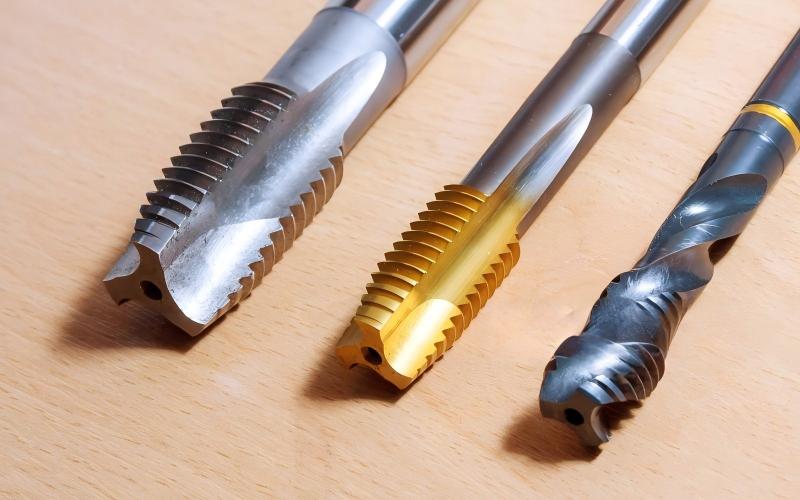
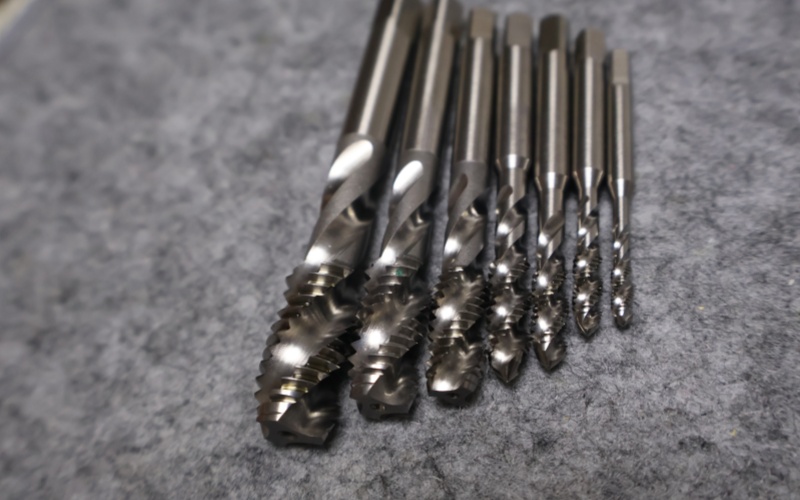
1.When tapping, the orifice of the end face should be chamfered; the tap must be coaxial with the hole of the workpiece; an axial pressure should be applied at the start of tapping to make the tap cut in, and no axial force is needed after the tap has cut in for a few turns.
2.When the calibration part of the tap enters the threaded hole, retract the tap by 1/4 to 1/2 turn after every 1/2 to 1 full forward turn. This allows the chips to break before continuing to tap downward. When tapping a through hole, frequently withdraw the tap to remove chips.
3.When tapping on steel workpieces, cutting fluid should be used; when tapping on cast iron workpieces, a small amount of kerosene can be added. After using the first tap (taper tap), when using the second tap (second tap) and third tap (bottoming tap), the taps must be screwed into the threaded hole.
4.When threading (with a die), the end of the workpiece should be chamfered, and the end face of the die must be perpendicular to the axis of the workpiece. Axial pressure should be applied at the start of threading, and the rotational pressure should be relatively greater; once the die has cut threads on the workpiece, no more pressure should be applied.
5.During threading, the die should be frequently reversed to break chips and ensure timely chip discharge.
6.The workpiece should be firmly fixed in a clamp or fixture. If the tap breaks, do not touch the broken part with your hands; use a chisel or center punch to pick out the broken tap. When dealing with a broken tap, safety goggles must be worn.