Threads are the most common method for connecting mechanical parts, and taps are the most frequently used tools for machining internal threads. Selecting taps correctly for internal thread machining ensures the quality of thread connections and extends the service life of the taps.
1.Selecting Tap Tolerance Zones
All machine taps made in China are marked with the pitch diameter tolerance zone codes: H1, H2, and H3 indicate tolerance zones at the same position but with different tolerance values. The tolerance zone code for hand taps is H4, which has larger tolerance values, as well as greater pitch and angle errors compared to machine taps. Additionally, their material quality, heat treatment, and production processes are not as good as those of machine taps. According to regulations, H4 may be unmarked. The internal thread tolerance classes that can be machined by the pitch diameter tolerance zones of taps are as follows:
Tap tolerance zone code Applicable internal thread tolerance class
H1 4H、5H
H2 5G、6H
H3 6G、7H、7G
H4 6H、7H
German manufacturers often mark them as ISO1 4H, ISO2 6H, ISO3 6G (the international standards ISO1-3 are equivalent to China's national standards H1-3). In this way, both the tap tolerance zone codes and the machinable internal thread tolerance zones are indicated.
2.Selecting the Thread Standard
There are three common systems for general threads: metric, imperial, and unified (also known as American). The metric thread uses millimeters as the unit and has a thread angle of 60 degrees. For example, "M8×1-6H" represents a metric fine thread with a diameter of 8 millimeters, a pitch of 1 millimeter, and an internal thread tolerance zone of 6H.
The imperial thread uses inches as the unit and has a thread angle of 55 degrees. For example, "BSW 1/4-20" indicates a thread with a diameter of 1/4 inch and a coarse pitch of 20 threads per inch; such threads are rarely used now. The unified thread, on the other hand, uses inches as the unit and has a thread angle of 60 degrees.
For diameters smaller than 1/4 inch, numbering is commonly used, where numbers from 0 to 12 represent diameter specifications ranging from 0.06 inches to 1/4 inch. The unified thread is still mainly used in the United States.
3.Selecting the type of tap
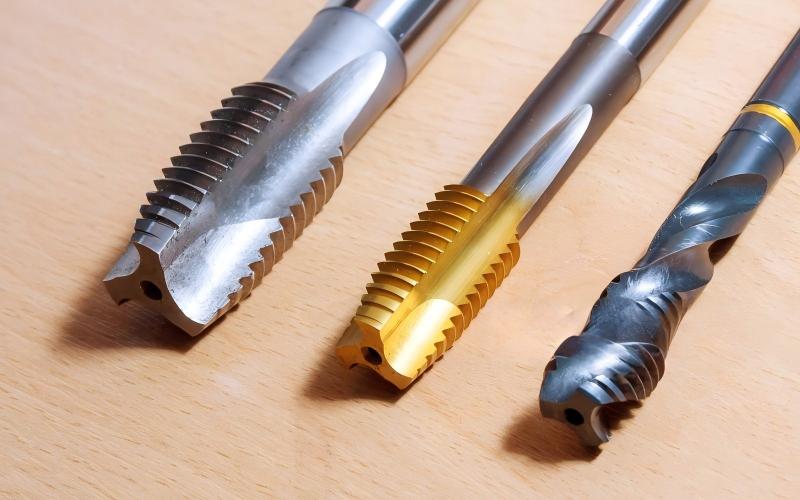
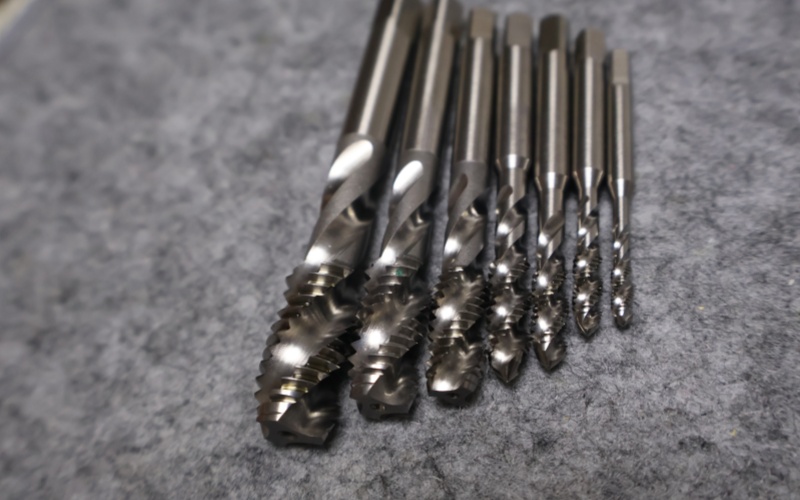
The types we commonly use are: straight-flute taps, spiral-flute taps, spiral-point taps, and roll-form taps, each with its own advantages in performance.Straight-flute taps have the strongest versatility. They can machine both through holes and blind holes, as well as non-ferrous and ferrous metals, and are also the cheapest. However, their specificity is relatively poor—they can do everything but not excel at anything. Spiral-flute taps are more suitable for machining blind-hole threads, as chips are discharged backward during processing. Due to the helix angle, the actual cutting rake angle of the tap increases as the helix angle becomes larger. Experience tells us that when machining ferrous metals, a smaller helix angle (usually around 30 degrees) should be chosen to ensure the strength of the spiral teeth. When machining non-ferrous metals, a larger helix angle (around 45 degrees) is preferable to achieve sharper cutting. Spiral-point taps discharge chips forward during thread machining. Roll-form taps are more suitable for machining non-ferrous metals.